Artificial Intelligence (AI) Is Everywhere - Its Real Value Starts With Understanding the Problem
AI is quickly becoming the most talked-about theme in public safety and healthcare, yet few organizations have a clear understanding of where it fits—or what problem(s) it actually solves. While vendors promote impressive before-and-after metrics, the real challenge for municipalities, paramedic services, hospitals, and frontline professionals remains the same: AI only creates value when the underlying workflow problem is fully understood.
Right now, that foundational step is being skipped.
The Policy Gap No One Is Talking About
Public-sector organizations have been slow to develop HR and governance policies around AI. Employees are already using tools like ChatGPT to draft memos, summarize reports, or automate repetitive tasks—but most municipalities still lack clear expectations around:
-
Acceptable use;
-
PHIPA and privacy safeguards;
-
Verification requirements;
-
Risk management;
-
Transparency when AI assists with content creation;
-
and most importantly, Intellectual Property (IP) ownership
The IP question is becoming critical.
If AI is used to build an internal tool or encode a proprietary clinical workflow into a model, who owns the output—the employee, the AI provider, or the organization?
No public safety agency or healthcare system has fully answered this yet, and the ambiguity poses significant operational and legal risk.
Vendor Claims Are High, Yet Clarity Is Low
At conferences like EMS World Expo, vendors increasingly promote “AI-powered productivity” or “AI workflow optimization.” But only a subset of SaaS companies—such as ImageTrend can clearly demonstrate how their AI Assist integrates into real work.
The problem isn’t the technology. It’s the storytelling.
Most vendors rely on numbers:
-
“25% faster documentation”
-
“30% fewer clicks”
-
“2× productivity improvement”
However, metrics without context are not convincing. They do not explain:
-
What the original workflow looked like;
-
What specific pain point the AI solved;
-
How the algorithm works in practice;
-
Which level of AI or machine learning is being used;
-
or where the model’s limits are
Visual workflow storytelling—especially through accurate 3D animations—is almost non-existent, yet it is the most effective way to help decision-makers understand why a solution matters.
The Frontline Perspective: "What's in it for Me?"
This is one of the most overlooked dimensions of AI adoption.
For example, ImageTrend’s new AI Assist technology can significantly reduce the cognitive burden and time required to complete an Emergency Health Record (EHR)—especially after complex cases such as cardiac arrests.
However, frontline professionals naturally ask:
-
If I finish my documentation sooner, will I simply get dispatched faster?
-
How does this technology benefit me today—not just in the long term?
-
Will my writing and reasoning skills erode if I rely on AI prompts?
These questions matter. In unionized environments, efficiency gains are often perceived as precursors to increased workload or staff reductions.
Organizations must clearly explain:
-
The immediate benefit to clinicians (reduced cognitive load, lower fatigue)
-
Safeguards that prevent workload inflation
-
How AI supports, rather than replaces, clinical reasoning
-
How documentation consistency strengthens clinical governance
Without this clarity, frontline adoption will remain cautious—even when the technology is strong.
The Real Workflow Opportunities (Where AI Can Actually Help)
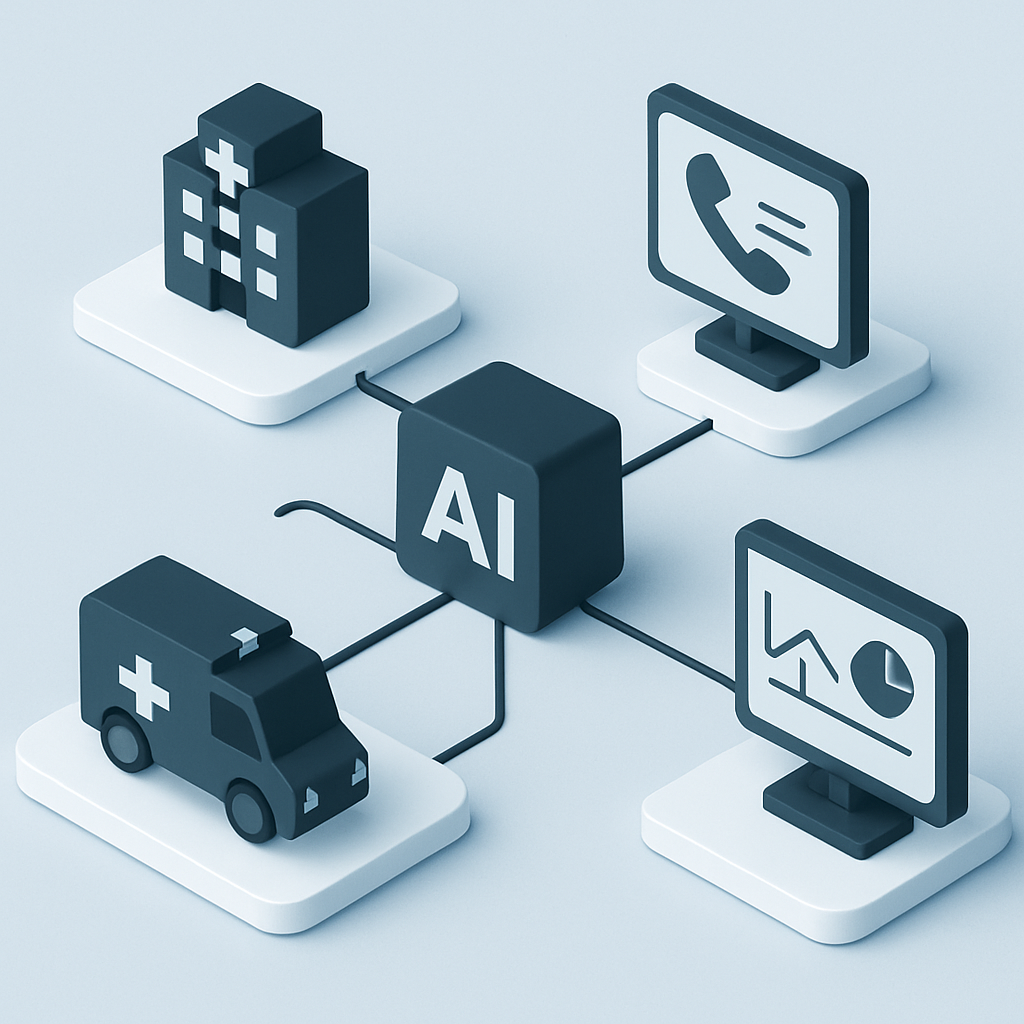
Beyond documentation assistance, AI has real potential to address operational gaps—if vendors and organizations focus on workflow first:
• Resource Allocation During Peak Hours
Predictive modeling can help services proactively plan for surges instead of reacting in real time.
• Inventory and Asset Management
AI can track consumables, medications, expiries, and equipment movement with real-time accuracy.
• Patient Handover Optimization
Integrating ED congestion data, bed availability, and offload delays into actionable insights could transform how paramedic services distribute resources.
• Cognitive Load Reduction for Complex Calls
Structured prompts, context-aware recommendations, and intelligent summaries can support clinical reasoning and improve documentation quality.
These are real, measurable pain points—but vendors often showcase the result without showing the journey - and frontline staff, supervisors, and chiefs need to see the journey.
The Real Future: AI That Understands the Problem First
The next phase of AI in public safety and healthcare won’t hinge on which vendor claims to have the most advanced model. It will hinge on organizations that:
-
Identify real workflow bottlenecks;
-
Build clear HR and governance frameworks;
-
Invest in transparent, visual storytelling;
-
Educate frontline staff on how the technology helps them;
-
Integrate AI in ways that enhance—not replace—professional judgment
AI is not magic.
AI is not a replacement for clinicians.
AI is a tool—and tools only work when the problem is well understood.
Stay Ahead of the Next Wave
Subscribe to EPEK Insights for clear, practical breakdowns of how innovation is reshaping public safety and healthcare - without the hype.




Comments (0)